
Phrases for Comparing Things in English
Can you talk about how things are different or better in English?
Maybe you want to compare two things you want to buy. The options are endless!
In this free lesson, you’ll learn typical English phrases that will help you:
- Talk about preferences and recommend options
- Ask for and give opinions when comparing things
- Use comparison words and expressions
Comparing things: example dialogue
This short conversation shows two friends comparing two bikes using natural English phrases:

Listen
Listen to the conversation. Try to hear each comparison and how the speakers explain their views.
Phrase guide: comparing things
Here's a breakdown of the phrases from the dialogue.
Saying one thing is better than another
These phrases all mean “X is better than Y.”
- It’s ten times nicer / better
- A better deal by far. (by far = definitely)
- It’d be way more ...................
- It’s a lot ............er compared to the …
- … just doesn’t hold a candle to it. ( = nothing could be better)
- You’ll be better off with it. ( = this would be a better choice)
- It’s the bee’s knees. ( = It's the best option)
You can also say:
- X is way better than Y.
- X is streets ahead of Y.
- X is just as good as Y.
Talking about which thing is more suitable
We heard this phrase in the dialogue:
- That bike’s more your kind of thing.
To say which thing is more suitable, you can also say:
- It’s more your style.
- That one’s more “you.”
- It would be right up your street. ( = It would be perfect for you)
- It suits you / It would suit you ( = it would be the best choice for your needs)
Saying that one option is worse than the other
These phrases are also from the dialogue. Use these to say if you think one thing is worse than the other thing:
- It's not worth the money.
- It's a load of rubbish.
- I’d probably steer clear of that … ( = you should avoid it)
- I wouldn’t touch that … with a bargepole.
You can also say:
- I wouldn’t go anywhere near it.
- I don’t think it’s a good choice.
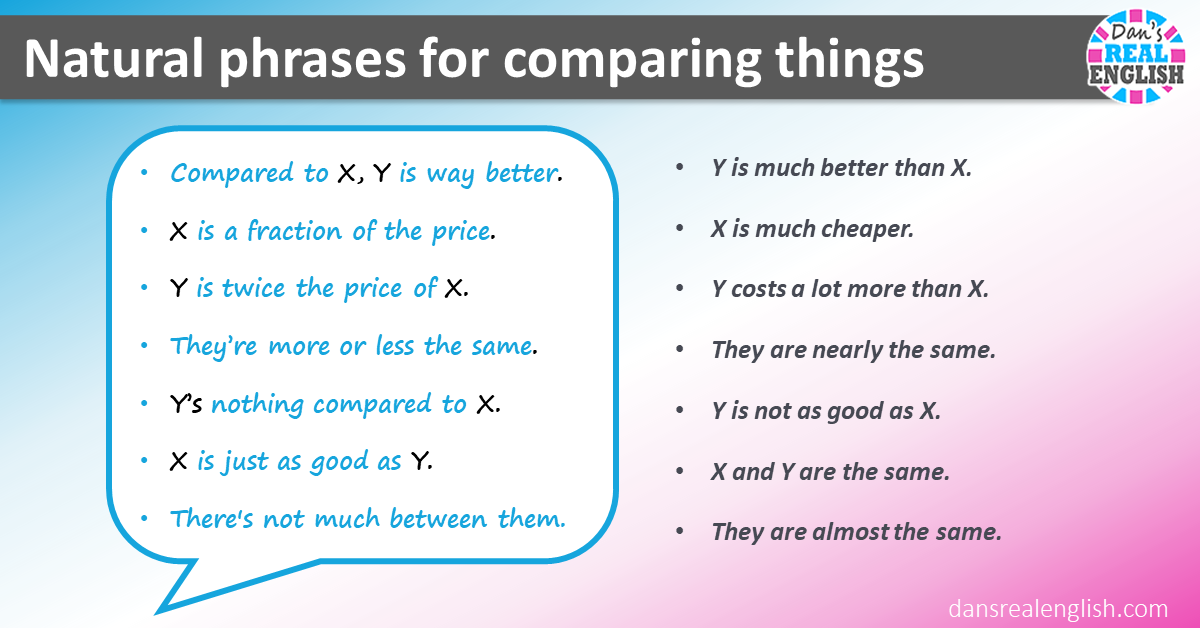
More useful phrases to compare things
Use these extra phrases to compare things in English.
Extra expressions
| Phrase | Plain English |
|---|---|
| Compared to X, Y is better. | X is better than Y. |
| X is a fraction of the price. | X is much cheaper. |
| Y is twice the price of X. | Y costs a lot more than X. |
| They’re more or less the same. | They are nearly the same. |
| Y’s nothing compared to X. | Y is not as good as X. |
| X is just as good as Y. | X and Y are the same. |
| There's not much between them. | They are almost the same. |
Pattern focus: using comparatives and modifiers
When we compare things in English, we often use words that show how big the difference is.
Look at these examples:
- Way more practical = much more practical
- Ten times nicer = a lot nicer
- A lot lighter = much lighter
These modifiers (like “way”, “a lot”, “ten times”) help show HOW different things are.
Try using these patterns when you make comparisons:
- X is a lot / way / far / much + adjective (e.g. nicer, cheaper)
- X is [number] times + comparative adjective (e.g. two times better)
If you're still stuck, you can find out more about using comparatives and superlatives here.
Exercises
Practise what you’ve learned with these simple activities.
1. Match the phrase to its meaning
- It’s the bee’s knees.
- That one’s more “you.”
- It’s way pricier.
- I’d steer clear of it.
- They’re more or less the same.
a. It’s really good.
b. I don’t think you should buy it.
c. They’re almost the same.
d. It costs much more.
e. It suits you better.
2. Match the phrases to a likely response
- A: I think the … looks better.
- A: I wouldn’t go near the …
- A: That …’s way more practical.
a. I know! It’s much lighter.
b. Yeah, I’d stay away from it too.
c. Really? I think the other one’s nicer.
3. Finish the sentence (speaking practice)
Complete the sentence, then try saying it aloud.
- I think the … is...
- Compared to the …...
- If I were you...
Answer key
1. Match the phrase to its meaning
- It’s the bee’s knees. → a. It’s really good.
- That one’s more “you.” → e. It suits you better.
- It’s way pricier. → d. It costs much more.
- I’d steer clear of it. → b. I don’t think you should buy it.
- They’re more or less the same. → c. They’re almost the same.
2. Match the phrases to a likely response
- A: I think the … looks better. → c. Really? I think the other one’s nicer.
- A: I wouldn’t go near the … → b. Yeah, I’d stay away from it too.
- A: That …’s way more practical. → a. I know! It’s much lighter.
3. Finish the sentence (possible examples)
- I think the … is more practical and better value.
- Compared to the …, it’s much lighter and easier to use.
- If I were you, I’d definitely go for it.


