Ways to Talk About the Future in English
Talking about everyday future plans, arrangements and events in English can be confusing:
After all, we use several different future forms for common real-life situations.
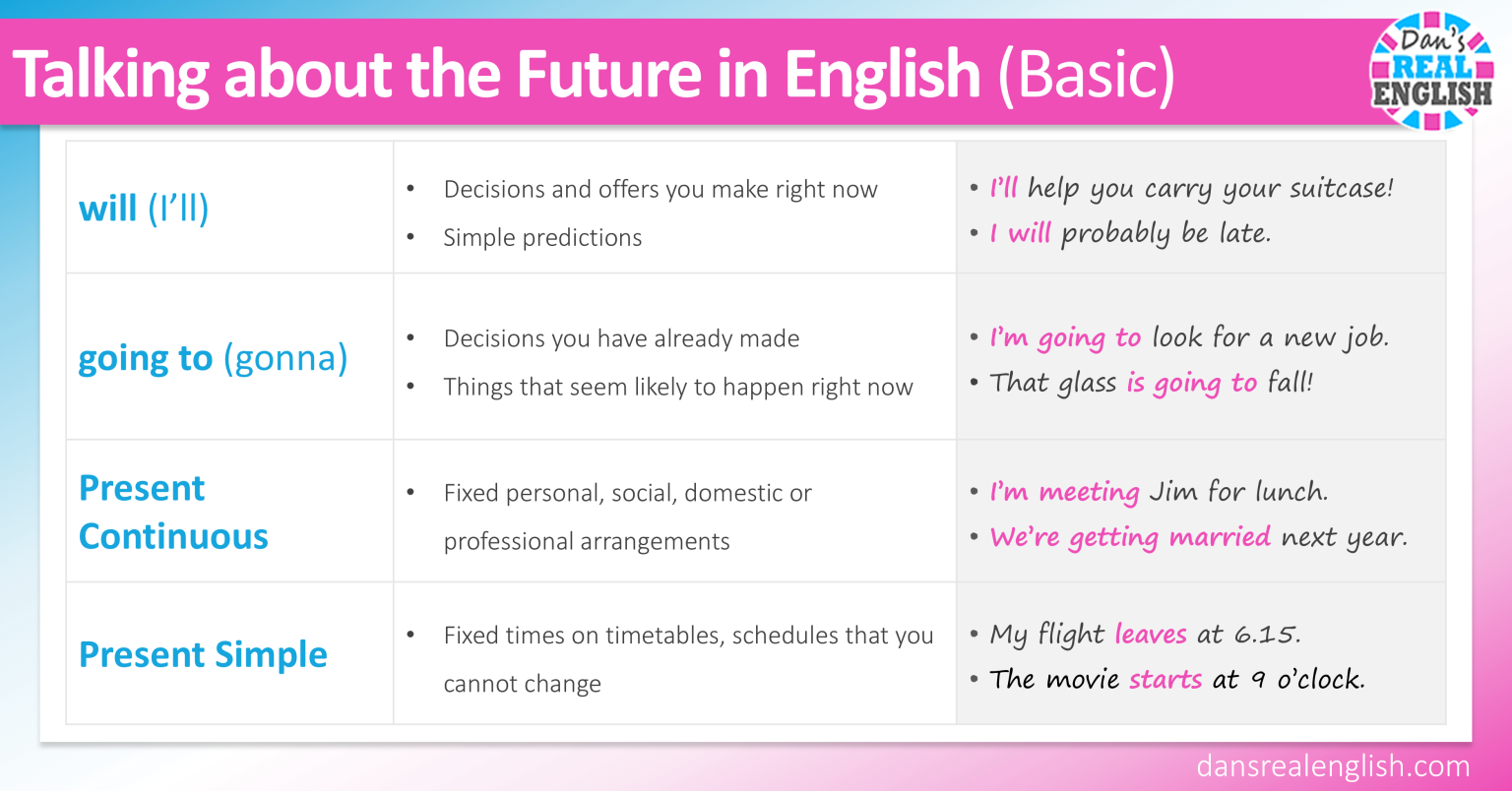
This short guide shows you how to use four basic forms, will, going to, present continuous andpresent simple, to express everyday future events in English!
Understanding everyday future forms
Here’s a detailed look at each future form in English:
Will (for “NOW” decisions)
We often use will for decisions we make RIGHT NOW for offers, promises, and immediate actions.
Examples:
- “I’m tired. I’ll take a taxi.”
- “You look cold — I’ll get you a blanket.”
Will (for predictions)
We can also use will when we are making predictions about the future.
Examples:
- “I think it will be quiet later.”
- “I won’t be long. / I don’t think it will take too long. ”
Pronunciation reminder (WILL):
In everyday conversations, we usually shorten WILL to ‘LL, and WILL NOT becomes WON’T.
Examples:
- I’ll see what I can do. = I will..
- She’ll let me know when she’s ready. – She will..
- I won’t call him unless you tell me to. – I will not..
We can use WON’T in questions or short answers:
- A: Won’t you be able to do this for me? = Will you not be able to do this..?
- B: No, I won’t I’m afraid. = No, I will not ..
But we never use ‘LL in questions or short answers:
- A: Will you be able to do this for me? (NOT : ‘ll you be able to..?)
- B: Yes, I will. (NOT : Yes, I’ll.)
Going to (for intentions)
We use going to to express intentions – to say what we want to do or plan to do.
Going to like this means we decided to do something before we started talking about it.
Examples:
- “I’m going to start eating more healthily from now on.” = I decided to do this earlier. This is my intention. I plan to do this thing.
- “We’re going to move house when our contract ends.” = We have decided to do this. We made this decision before I told you about it.
Going to (for likely, near future events)
We can also use going to when something happening NOW makes you think that something will happen very soon.
If you can see that something is likely to happen soon, use going to:
Examples:
- “Oh my God, It’s pouring with rain! We’re going to get soaked!” = The rain is really heavy – we can’t avoid it.
- “Hey watch out! That glass is going to fall off the table. Grab it! = Something bad is about to happen. Do something, now!
Pronunciation reminder (GOING TO):
When speaking, we usually shorten GOING TO to “GONNA“:
Examples:
- I’m gonna try and fix this problem tonight. = I’m going to try and ..
- Look out, it’s gonna fall! = It is going to fall.
Present continuous (for arrangements)
Yes, we usually use present continuous to talk about the present (now)! But we also use this tense for the future.
Forms like “I’m leaving tomorrow” are for arranged or fixed future plans, especially social, domestic or professional contexts.
If you have an upcoming event in your calendar (like a party), use present continuous to talk about it!
Examples:
- “I’m having my hair cut next week.” = I booked the appointment – it’s in my diary.
- “I’m meeting up with Anna tomorrow.” = We arranged this yesterday – it’s a date. I’m not free to arrange anything else at this time.
- “We’re having some friends round next week.” = I asked some friends to visit last week – they agreed – it’s in our diaries.
- “She‘s not working tomorrow.” = This arrangement has been agreed. She is off work tomorrow.
- “We‘re having the house painted next week.” = We called a painter last week and they agreed to do the work next week. It’s in our diary.
Present simple (for fixed schedules)
Like present continuous, we usually use present simple to talk about present routines and facts, etc.
But we can also use present simple to describe fixed future events that follow scheduled times.
Examples:
- “The train leaves at 8:04.”
- “My appointment starts at ten.”
- “The shopping centre opens at nine.”
Stronger and weaker future forms
If you want, you can add words and phrases to future forms to make them sound stronger or weaker.
Maybe I’ll / I think I’ll, etc
Words like “maybe” , “think” and “probably” make decisions, offers and predictions sound softer, less direct – and sometimes more polite.
As a rule, “I think..” often comes before “will” decisions, especially in British English conversations.
Examples:
- “Maybe I’ll go, maybe I won’t.”
- “I don’t think I’ll bother.”
- “I think I’ll have a cup of tea, now.”
- “I’ll probably be busy at that time.”
- I’ll most likely need some help with that.”
I’m definitely going to / I’ll certainly..
Words like “definitely” and “certainly” make plans or decisions sound stronger and more sincere:
Examples:
- “I’m definitely going to apply.”
- “I’ll certainly try to call you later.”
Future tenses- spoken examples
Here are some examples of everyday future forms as English speakers use them in real situations.
Can you see which future form is used – and why?
A short dialogue
Two colleagues finishing work for the day.
- A: Are you heading off now? (heading off = starting a journey / going back home)
- B: Yeah, but the traffic looks horrible. I don’t think I’ll be home till gone six. (“..till gone six” = ..until after 6pm)
- A: Well at least you’ll be on your way home – I’m meeting a client at six this evening, so I’ll still be here.
- B: Sorry to hear that, mate. By the way I’m going to set up the meeting for James tomorrow if that’s OK. I don’t have time right now.
- A: No worries ,that’s fine. But don’t forget that the meeting with Amy starts at 9 tomorrow, so if you could try to get here on time..
- B: Sure, I’ll probably be in at around 8.30, so I think we’ll most likely have enough time to set things up before she gets here.
Diary entry
Thinking about tomorrow morning.
“Tomorrow’s going to be really busy. I’m meeting Sam at 8:30, and the train leaves at 7.30, so I guess I’ll have to leave early. I’m going to make a list tonight so I don’t forget anything. I think it will be crowded, though — it usually is on Fridays.”
Future forms: key points to remember!
Here are some easy-to-remember rules about using future tenses in English:
- Will = decisions now + simple predictions
- Going to = earlier plans + predictions with evidence
- Present continuous = arranged plans (social, personal, work)
- Present simple = fixed schedules
- Words like I think, maybe, probably, definitely change the meaning and show how sure you are
- Choose the form that matches how you see the future event: open, planned, arranged, or fixed
Future tenses: mistakes to avoid
Here are some common mistakes that English learners sometimes make when using future tenses.
Using WILL all the time
Learners sometimes choose WILL , even though they are talking about a plan or arrangement:
Incorrect:
- “I will meet Anna tomorrow.”
- “I will go to the dentist tomorrow.”
Better:
- “I’m meeting Anna tomorrow.”
- “I’m going to the dentist tomorrow.”
Using WILL after, when, before, after, until
These time words already show the future, so we use a present form after them.
Incorrect:
- “When she will arrive, we’ll start.”
Correct:
- “When she arrives, we’ll start.”
Using GOING TO without BE
This is a very common mistake because we say it quickly in speech.
Incorrect:
- “I going to do my work…”
- “He going to see a movie…”
Correct:
- “I’m going to…”
- “He’s going to…”
Using present simple for personal plans
Present simple is for timetables and schedules – not for your own plans! Use going to or present continuous instead.
Incorrect:
- “I go to London tomorrow.”
Correct:
- “I’m going to London tomorrow.”
- “I’m going to London tomorrow.”
Using present continuous for intentions
Present continuous is for arranged or fixed plans that you cannot control. If it is only your plan or intention, use going to.
Incorrect:
- “I’m watching TV tomorrow morning.” (only correct if this is a real arrangement)
Better:
- “I’m going to watch TV tomorrow morning.” = I want to / I intend to watch TV tomorrow.
Saying “probably” before “will”
The word probably normally goes after will.
Incorrect:
- “Probably, I’ll go.”
Correct:
- “I’ll probably go.”
Basic future tenses exercises
These grammar exercises will help you practise the different future tense areas we have covered in this session:
Exercise 1: Choosing the Correct Sentence
1. You arranged this meeting with Anna last week.
2. Your friend is carrying six heavy shopping bags at once. You can see what will happen.
3. You’re talking about a plan that you decided earlier this week.
4. You want to talk about a timetable.
5. Choose the correct sentence after when.
6. You have a free morning tomorrow. You think you might watch TV after you wake up.
7. You have a dentist appointment. It’s arranged.
8. Someone needs your help right now.
Exercise 2: Choosing the Best Future Form
1. Which is the right way to say you may be late?
2. You’re writing a polite work email about a future action.
3. You are giving your opinion about the future.
4. You have already decided to change jobs, so you say:
5. This fixed, official event is timetabled.
6. You arranged this meeting weeks ago.
7. You want to express a plan that you have decided on.
8. You’re thinking out loud and giving a simple future opinion.
Your final score
Total: 0 / 0