Mixed Future Tenses in English
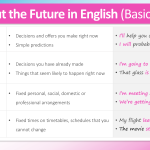
You can maybe already use basic future tenses like WILL and GOING TO.
How about learning how to use more advanced, mixed future tenses in English?
In this free English grammar lesson, you will learn how to use mixed future tenses and forms to talk about:
- an action in progress at a future moment
- an action completed before a future moment
- how long something continues up to a future moment
- a plan or intention in the past that changed
- future meaning inside time clauses without using will
You can also try the mixed future tenses exercises at the end of the lesson if you want more practice!
Advanced future tenses: quick view
| Future continuous | An action will be in progress at a future time | I will be driving at that time. |
| Future perfect | Something will be finished before a future time | We will have arrived by 6pm. |
| Future perfect continuous | Show how long something continues up to a future point | We will have been driving for 3 hours. |
| Was / were going to | A past plan/expectation that changed or didn’t happen | I was going to visit you, but I ran out of time. |
| Future time clauses | Show a future meaning, but the verb looks present | We‘re due to leave at 4pm. |
Understanding mixed future tenses and forms
Let’s look in more detail at how mixed future tenses work – and how to use each form.
Future Continuous
Future continuous tense works just like present continuous – we just make it future!
I am working now → I will be working then
Use this to show we’ll be in the middle of an action at a future time.
Examples:
- This time tomorrow, I will be travelling.
- At 10pm tonight, we will be having dinner.
- Don’t call late — they will be sleeping.
Future Perfect Simple
You can use future perfect simple to look forward to a future time — and imagine looking back from it!
Yes, it sounds confusing, but this tense is useful if you want to say that an action will be completed at a point in time in the future.
Examples:
- By Monday, we will have finished the report.
- In 10 years, many jobs will have changed completely.
- By the time you arrive, they will have left.
Signal words: by, before, by the time, in + time period
Future Perfect Continuous
Like future perfect simple, but it is focused on duration, not completion.
Use it to show how long something will have been happening by a point in the future.
Examples:
- By June, I will have been working here 5 years.
- When you land, we will have been waiting for 2 hours.
- Next summer, she will have been studying English for 6 years.
Signal words: for + duration, by + date/time
Was going to (mixed future tense)
We use was/were going to for plans in the past that changed or didn’t happen.
Examples:
- I was going to call you, but I didn’t have time.
- We were going to move, but we stayed instead.
- She was going to start a course, but changed her mind.
Advanced future tenses in context
This monologue shows you how mixed future tense forms might be used in a natural, business context:
This time tomorrow, I’ll be travelling to Manchester for a conference. I’ll be on the train all afternoon, and by the time I arrive, hopefully, my evening meal will have been prepared. I was going to drive, but the traffic would have been awful on a Friday. By next week, I’ll have been working on this project for almost a year, and if everything goes smoothly, I’ll have finished my section before the second day.
Mixed future tenses: mistakes to avoid
Here are some typical errors that learners make when using mixed future tenses:
✘ I’ll work at 3pm tomorrow. → sounds like a decision
✔ I’ll be working at 3pm tomorrow. → in progress at that time
✘ We’ll finish by Monday. → finishing on Monday, not before
✔ We’ll have finished by Monday. → completed earlier
✘ By June, I’ll work here five years. → no duration sense
✔ By June, I’ll have been working here five years.
✘ I was calling you, but I didn’t. → interrupted action
✔ I was going to call you, but didn’t have time.
✘ Once you will finish, we’ll start.
✔ Once you’ve finished, we’ll start.
Mixed future tense exercises
These exercises will help you practise using mixed future tenses correctly in everyday situations:
Exercise 1: Advanced future forms (meanings)
Choose the sentence that best matches the meaning.
1. An action still in progress at 3pm tomorrow.
2.A task which will be complete before Monday.
3.A period of time up to June.
4. A past plan that changed.
5. The meeting will end at 4.45pm.
Exercise 2: Advanced future forms (situation-based)
Choose the sentence that best matches the situation.
1. You will start your journey at 5pm and arrive at 7pm.
2. The work will be complete before your boss returns on Monday morning.
3. You moved to your house in July, nearly two years ago.
4. You didn’t go yesterday, but you wanted to.
5. The presentations will end, then you will arrive — you will miss them.
Your final score
Total: 0 / 0